
Over the last few weeks I have been out again with the lovely volunteers who are fully trained and have a special BTO license to handle and ring birds. They have very kindly allowed me to tag along again this year so that I can share with you all what I have seen. To be honest it is not just to share with you all, I enjoy my time out with them and learn a lot about the nature in the park. They are full of useful information which they are more than happy to share with me. Just a quick note...Please don't forget that it is against the law to disturb a nest or nesting birds without a special BTO license. I myself just record what happens with my camera.
With the help of these lovely volunteers, I have been able to record the different stages of both the Blue Tits and the Great Tits. Here are the different stages of the Blue Tits. Great Tits eggs are identical only a little bigger.

These hatched chicks will only be about 2-3 days old. You can see there are still two more eggs to hatch.

These are maybe a day or two older.


It always amazes me how quickly birds grow. The volunteers check the bird boxes only once a week and the difference from one week to another is amazing. The birds in the box below would have left the nest before the next check.

Just to show you the difference at this stage, here is the Great Tits.


Back to the Blue Tits. A couple of photos from last year of some Blue Tits being fed by a parent at Charlecote.


Early June is when many Blue and Great tits fledge but they will still stay close to their parents as the parents will carry on feeding them for a few weeks.

This year being inside a bird box, I was able to see this amazing bird up close as the volunteers ringed the owlet which allowed me to photograph it. I love Owls by the way. I think they are beautiful birds.
Here it is at about 18 days old.

I love the expression on the owls face below.

Tawny Owl around 25 days old. You can see the feathers at he bottom of the wings starting to appear.

This Owl is now leaving the bird box and climbing the tree and they are very good climbers. You have to look very carefully to spot them high up in the trees. It will still use the box until it fledges but it will leave it more often now.

Last year we were really pleased to have two sets of Barn Owls. This year it looks like we might have three sets but we won't know for sure until later this month. The Barn Owls are not disturbed until later in the month when it is safe to do so. All evidence around the nesting areas says we have three sets so I for one, am really looking forward to the end of this month. The Kestrels are still around but not nesting in the same box they did last year as like with many bird boxes, the squirrels have taken over. The Kestrels will be in a cavity in an old tree somewhere within the park but it is impossible to check them all so this year, we might just have to enjoy watching them fly above our heads. To see the Kestrels from last year, here is the link...http://janaruzena.blogspot.co.uk/2014/06/fawns-barn-owls-and-kestrels.html
I have also seen a Red Kite often flying over Hill Park. A beautiful bird. The little Owl has been harder to spot this year and their bird boxes were also taken over by squirrels. There is one that has been seen by the edge of the Park but I can't say if it is nesting inside or outside Charlecote Park. I am not giving up on them though and will try my best to find one for you along with getting the Kingfishers to sit still for a second or two to have their photo taken!
Next we have the Jackdaws which are of great interest to me this year as I also have some nesting in my roof!
Here are a couple of pictures of Jackdaws at a young age.

Just a few days makes such a difference. The feathers are really starting to grow now and the bird is more alert.

Look at those blue eyes.

The Great Spotted Woodpecker was spotted by a visitor who kindly told me where it was nesting. Over the years I have heard the Woodpeckers often but have found them harder to photograph. I was so happy when going in the next morning to find this picture in front of me. It was a lovely start to my day,
The first picture shows the female with one of her young.

This next picture shows the male feeding the young. The way to tell the difference between a male and a female Great Spotted Woodpecker is that the male has a red bit on the back of his head. All chicks have red heads.


I managed to get a short video of the woodpeckers so have put it together with some of the photos. Hope you like it.
The Grey Wagtail has been spotted in many places around the park. They normally like to be near running water so can often be found close to a river, waterfall or a stream. They are beautiful birds which are often confused with the Yellow Wagtail as they both have yellow on them but the Grey Wagtail has a grey head.


In a different spot I saw a female with what looks like two fledglings. It was a little far away to see properly. The males as above have the black on their necks but females don't.


There are plenty of Robins around and they can often be seen fluttering around the Woodland Garden.

Next we have the Chaffinch which is native to this country. A male is much bright in colours than the female.

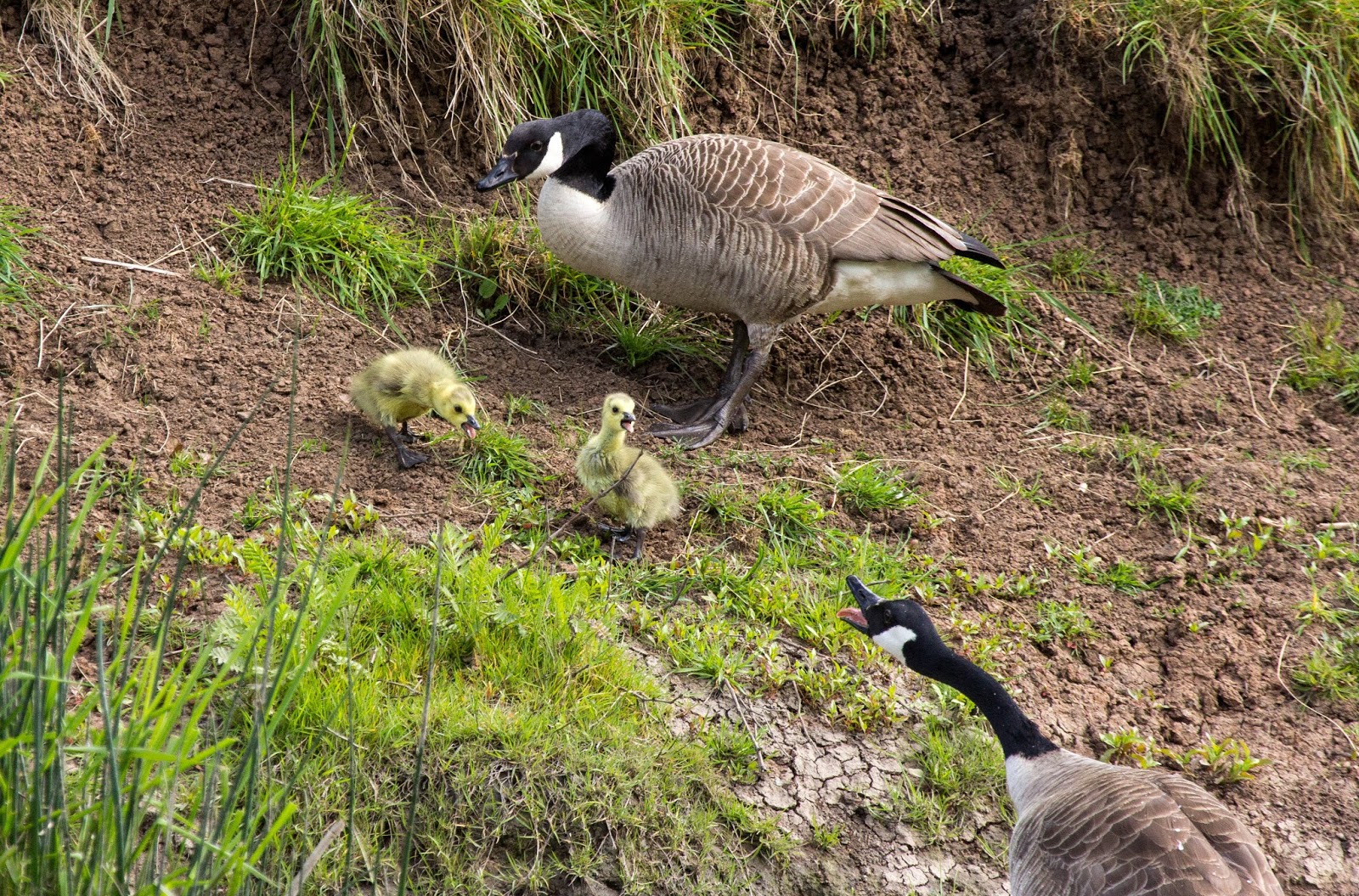
There are a few sets of Canadian Geese on the River Avon which runs through the park. You can spot them at different stages of growth and sizes.

I have spotted four Canadian geese families so far but there could be more.
Young goslings.


And a little older but not by much. They will turn greyer as they get older.

In the next photo it looks like the goslings are arguing with one of the parents.
A little video for you.
There are also plenty of ducklings to be spotted but I am still waiting to see what the Swans have to offer this year. I can see where they are nesting but I have not seen any young yet but that doesn't mean they don't have any as sometimes it is hard to see.

Mallards

Beautiful ducklings which are always very cute when they are this young.


There are two sets of Coots on the lake but they are not easy to photograph this year in their nests because of where they are nesting but here is a picture from last year. I will get some better pictures when they start swimming around the lake.

An adult Coot out of the water.


Look out for the Moorhens on the lake, they are a little shy.

That's my catch-up for my Charlecote Springwatch on the birds but by no means is that all. There are far too many birds to cover within the park. These are just some I have been able to photograph and share with you all.
I love the time I spend at Charlecote Park and love volunteering there. It gives so much back and a much needed break from my day to day life as a carer.
My challenge for this week is to try and catch the Kingfishers on camera and to also see if I can get a Fawn or two for you as the first one has already been spotted at Charlecote Park. Also to come soon are the ever changing colourful gardens and the beautiful meadow so watch this space!
A big thanks to all the Volunteer Licensed Ringers who kindly let me join them and allowed me to take photos. Much appreciated.
Hope You have enjoyed this blog
Copyright Jana Eastwood.


.jpg)


